
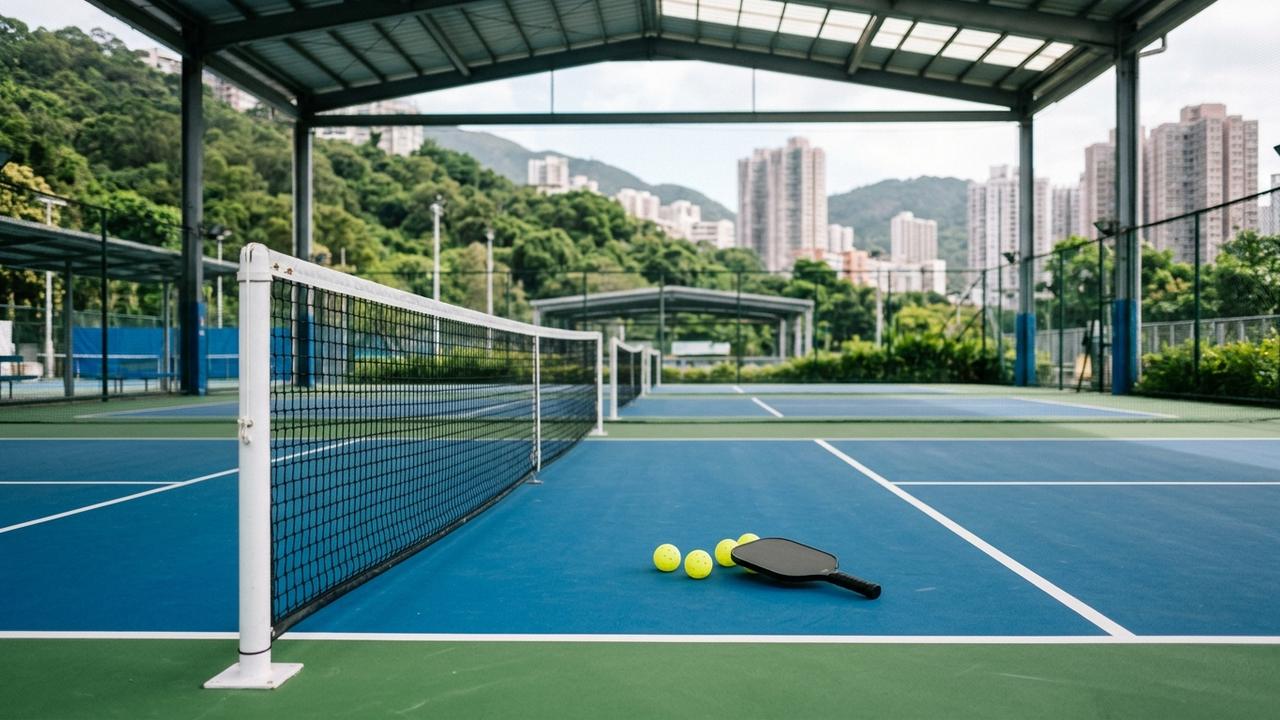
In Ma On Shan, learning pickleball rules before your first game can make each rally easier to follow. This guide explains what happens in play order, from the serve to the final point. At MYT Whitehead Pickleball Training Grounds, four covered, open-sided courts are available for booked sessions.
The venue is at No. 1950, Whitehead, and Wu Kai Sha is the nearest MTR station. Use the steps below to learn the calls, then agree how your group will settle close decisions.
Pickleball rules: court, net and kitchen layout
Start with the court layout, because it explains where a serve must land and where volleys are restricted. The net divides the two sides, and each side has a service area set diagonally opposite the server. Beside the net is the kitchen, also called the non-volley zone. The kitchen is not a no-entry area; the main restriction is hitting a volley while touching it.
For pickleball rules for beginners, learn to recognise three areas: the service boxes, the kitchen, and the rest of the playing area. A ball landing in a service box can be in play, while a serve landing in the kitchen is a fault. During a rally, a ball may bounce in the kitchen and still be played. You can step into the kitchen to hit a ball after it bounces.
Pickleball serve rules and the diagonal target
The serve starts each rally, so make sure the server and receiver are ready before play begins. In doubles, serve diagonally from behind the baseline into the opposite service area. The serve must clear the net and cannot land in the kitchen or on its line. A serve that lands outside the correct area, fails to clear the net, or breaks a serving rule is a fault.
After a serve fault, identify what happened before restarting. Check whether the serve went into the net, missed the diagonal service area, or landed on the kitchen line. The kitchen line is excluded from the legal service area, so a serve touching it is out. Agree on a clear call, such as "short" or "wide," instead of debating several possible faults at once.
The two-bounce rule explained in rally order
The two-bounce rule sets the order of the first shots after every serve. First, the serve must bounce on the receiving side before the receiver returns it. Then that return must bounce on the serving side before the serving team hits it. USA Pickleball's guide to how to play explains this sequence alongside the serve and kitchen rules.
Here is the rally in simple steps: serve, let it bounce, return it, then let that return bounce. After those two required bounces, either side may volley or play the ball after a bounce. A volley means striking the ball before it touches the ground. The rule does not require two bounces on each side; it requires one bounce from each side at the start of the rally.
This two-bounce rule explained in a short phrase is: "serve bounce, return bounce, then choose." If a player hits the return before it bounces on the serving side, that is a fault. The same applies if the receiver volleys the serve before it lands. Once both required bounces have happened, the rule no longer limits when you may volley.
If your group keeps forgetting the order, say the sequence aloud during a practice rally. You can also have one person watch the first two shots and call "bounce" each time. That is a practice aid, not an extra rule. It helps everyone distinguish the required opening bounces from later shots, when a volley is allowed if the player is outside the kitchen.
The kitchen rule, faults and fair line calls
The kitchen rule applies to volleys, not to every shot played near the net. You may enter the kitchen to hit a ball after it bounces, and you may stand there while an opponent plays. But you commit a fault if you volley while touching the kitchen or its boundary line. The rule also applies if your momentum after a volley carries you into the kitchen.
For a legal volley, stay outside the kitchen and off its line through the action of hitting the ball. Do not assume that stepping back after contact fixes a fault caused by momentum. This kitchen rule is easier to remember as "no volley from the kitchen, and no falling into it after a volley." The official USA Pickleball rules provide the formal wording.
Use a simple line-call routine when a ball lands close to a boundary. Pause, name the line or rule in question, and say what you saw without guessing. A ball touching a boundary is generally in, but a serve touching the kitchen line is a fault because that line is not part of the service area. If you could not see the landing clearly, say so and settle the point fairly with the other players.
Keep the disagreement about the call, not the person who made it. For example, ask whether the ball landed on the line or beyond it, then agree on the next step. This checklist works for new groups: stop play, identify the relevant line or rule, describe what you saw, and agree before restarting. It gives everyone a consistent way to handle close calls without turning each one into a long argument.
Doubles scoring, score calls and side-outs
In doubles scoring, call three numbers before the serve: the serving team's score, the receiving team's score, and the server number. The server number identifies which partner is serving in that turn. At the start of a game, the opening server is treated as the second server for the first service turn. If those calls feel unfamiliar, say them slowly and check that both teams agree before serving.
In the usual two-server rotation, the first partner serves until their team loses a rally. Then the second partner serves, and a further lost rally sends the serve to the other team. A side-out does not award a point to the receiving team under traditional scoring.
Instead, that team gets its turn to serve. Keep track of which partner served first so you know whose turn follows.
Conclusion
Pickleball rules are easier to follow when you learn them in rally order. Serve diagonally, allow the first two required bounces, avoid kitchen volleys, then track the score and server rotation. For pickleball rules for beginners, those steps cover the main decisions you will face during a standard doubles game.
Before play, make sure everyone understands the kitchen line, the serving order and how you will handle close calls. In Ma On Shan, you can use this guide to prepare for a session at MYT Whitehead Pickleball Training Grounds. If a rule is still unclear, pause and agree on the call before the next rally begins.
Book a court
MYT Whitehead Pickleball Training Grounds has four covered, open-sided courts, with up to 12 players per court booking (players 5 to 12 pay HK$50 each per hour). Sessions are one, two or three hours and start on the hour. The booking section shows live court availability. Pick a time and book your court at MYT Whitehead Pickleball Training Grounds: https://genium-sport.com/#book
FAQ
What are the 5 basic rules of pickleball?
The basics are to serve diagonally, let the serve and return bounce, avoid volleying in the kitchen, keep the ball in play, and follow the score and serving order. These pickleball rules cover the main choices in a standard rally. Learn the opening sequence first, then add the scoring details as you play.
How do pickleball rules work?
A rally starts with a diagonal serve, followed by one required bounce on each side. After those bounces, players can volley unless they break the kitchen rule or commit another fault. Under traditional scoring, only the serving team scores, and the game is won by a two-point lead.
What is the two-bounce rule in pickleball?
The two-bounce rule means the serve must bounce before the receiver returns it, and that return must bounce before the serving team hits it. This two-bounce rule explained simply is "serve bounce, return bounce, then choose." Afterward, either team may volley if the player is not in the kitchen.
Can you volley in the kitchen?
No, you cannot volley while touching the kitchen or its line. The kitchen rule also makes it a fault if your momentum carries you into the zone after a volley. You can enter the kitchen to play a ball after it bounces, so standing there is not automatically a fault.
How does doubles scoring work?
In traditional doubles scoring, only the serving team can score. The serving team calls its score, the receiving team's score, and the server number before serving. A side-out changes which team serves, while a game is usually played to 11 and must be won by 2 points.